I’M A MOUNTAIN BLUEBIRD
There I was in the Utah Canyonlands, 23 years old, alone, fasting, exposed, crying out to The Gods in a storm, “What is my Soul’s True Name??” And The Gods replied, as they do, not thru verbal language but with a flock of hundreds of screaming, shrieking birds suddenly landing upon the tall pine trees before me. And when I, in fact, asked them “what bird are you?” one immediately swooped right in front of my face and revealed itself to be an undeniable bright blue. And when I said aloud the word, “bluebird,” I instantly started bleeding from the nose and crying at the same time, and it felt like it was tears of blood, and then I jussknew that was the name.
Years later when I got into birding I realized that the behavior and habitat most likely pointed to Pinyon Jay, an unpredictable, elusive species which would be pretty thrilling for me currently, but back then because it was blue and in the mountains I assumed it was the Mountain Bluebird, and that’s the species that I have identified with ever since.
WHAT BIRD ARE YOU?
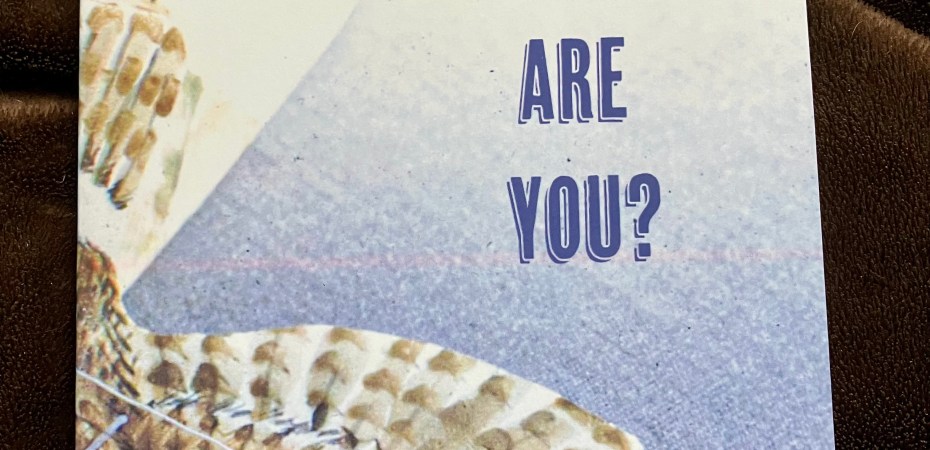
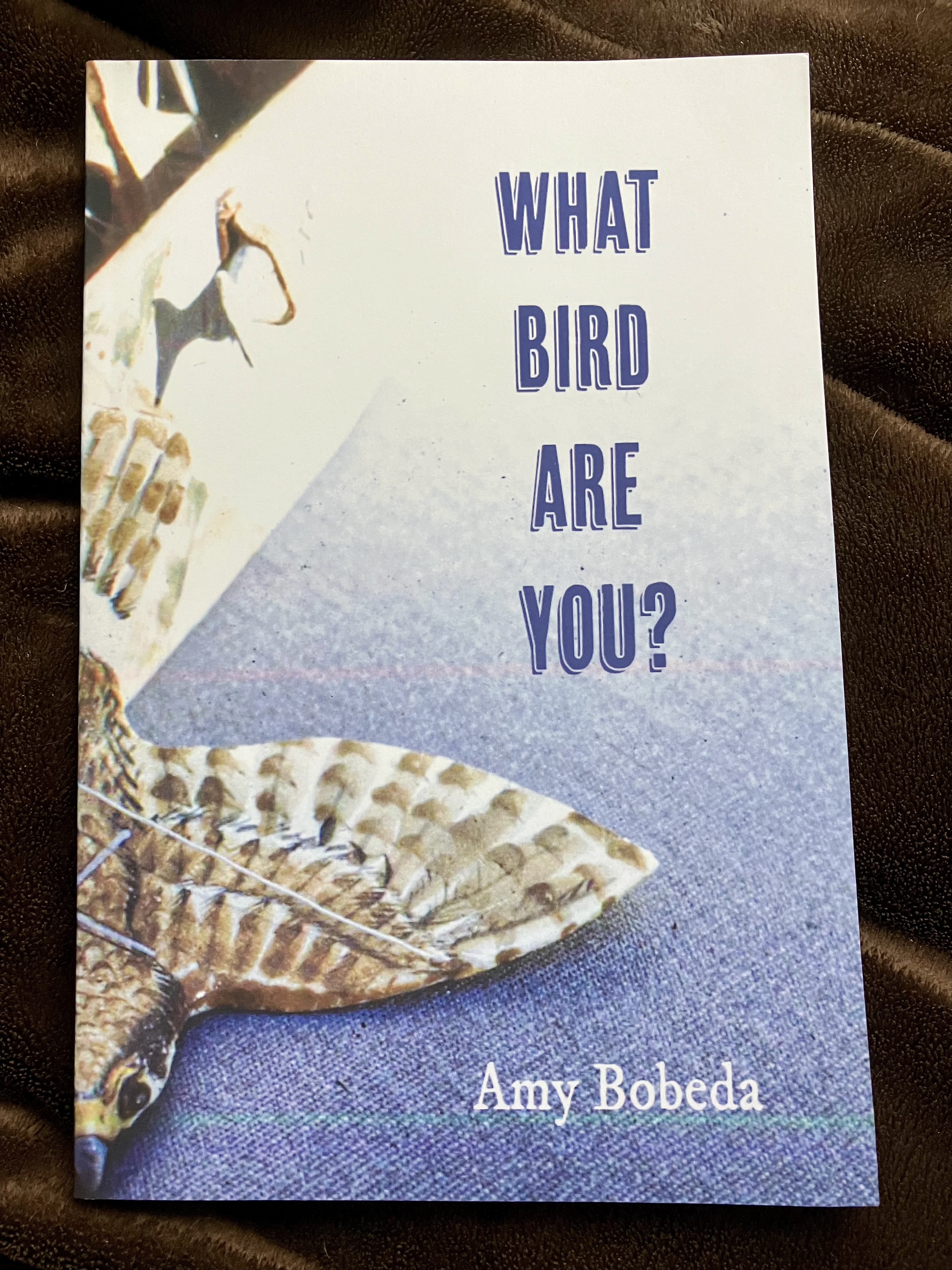
Anyway, I just read Amy Bobeda’s poetry book “What Bird Are You?” (Finishing Line Press 2023) and felt compelled to answer that question publicly via book review.
How did I come across it? It was kinda the opposite of shouting to The Gods at the edge of a canyon. She was one of my “people you may know” on Facebook and out of curiosity I clicked on her profile and saw her cover photo had the cover of the book. I DM’d her on Instagram thru the Boulder Poetry Scene account and asked if it was really about birds, and she said it was.
In addition to the topic of the book, I was also curious about the author, or at least my relationship to her. I feel like more than a “person I may know” she’s a person I should know – Not only do we share the same interest in birds and poetry, we are both Kerouac School graduates and currently teach composition and tutor in our school’s writing centers (her at Naropa, me at FRCC). But with the exception of a couple years back at a Naropa comedy night, at which my 80s cover/poetry band, Girls Just Wanna Have Us, played a parody version of Berlin’s “Take My Breath Away,” and she read menstruation poetry, we have somehow not had the pleasure of actually meeting or really crossing paths.
Is this more cuz of me, her, or the fractured social landscape of 2020s America? I don’t know; I’m not sure I really want to get into the weeds with any of it right now, especially my increasingly reclusive tendencies and retreat from the Boulder Poetry Scene project over the last couple years. I’ll just say I’m more in a reaching out kinda mood, at least at this moment, and, as someone who often chooses the weirdest ways to make acquaintances with someone, here is a review/analysis of her book, focusing on a few of the pieces which resonated most with me…
“MANHATTAN BIRD ALERT”
First, the title of the book is no decoy; it is very significantly about birds.* (*Scroll to bottom for my checklist on all the species mentioned in the book.) While Bobeda’s poetry covers a wide variety of themes and subject matter – family, art, mythology, place, gender, and the greater natural world – it’s central grounding is in the birds, whether referring to real life observations and reflections (Barry the now deceased Barred Owl of Central Park) or more metaphorically (“if you want a parrot you must paint him yourself”). While the other aspects of life may contain confusion and chaos there is refuge in the stability and beauty of birds.
The poem “Manhattan Bird Alert,” which I believe is a reference to a birding account on Twitter, seems at first glance to be simple observations of various bird species in New York City, almost like a birding checklist…
red neck loon paddles/ great blue rising/ Pelham Bay grebe
(Btw, as a birder, I appreciate that this one in particular contained so many specific species names, tho it’s actually a pet peeve of mine that they’re not capitalized! ha).
But I think the piece speaks to a larger theme of the intersection of humans and the natural world. Central Park itself is a birding phenomenon, an oasis amidst the urban landscape, where impressive numbers and variety of migrating birds along the Atlantic Flyway concentrate during the spring and fall. The absence of humans and civilization in the poem is telling; just from reading this you would never know these birds and the observer are surrounded by skyscrapers and traffic and masses of people. Here the birds of Manhattan are powerful enough to erase them if only for that moment.
And this power similarly holds true in the nomadic poet’s other inhabited or encountered geographic locations which surface throughout the book – Northern California (where she grew up); Sky City, New Mexico; Sedona, Arizona (where I’m actually currently writing this at my parents’); and Lafayette, Colorado (where she currently resides). In the latter, there’s mention of a Walmart where she observes Bald Eagles, and, in this case, the mundane, ubiquitous corporate symbol is erased not by omission but by elevation thru juxtaposition with the birds. In that piece, entitled “The Lovers,” the speaker describes herself as having “an affair” with the powerful Eagle, and, in a way, the audience is likewise allured by each bird referenced throughout the book.
I’ll also note the visual layout of “Manhattan Bird Alert” is one of the more liberated in the collection, with lots of varied space separating mostly small word clusters, which gives a sense of breath, patience, and freedom. And it also contains, as a nice touch, as does several other pieces in the book, one of Bobeda’s original bird drawings – an elegant little hawk.
“IN THE KITCHEN”
Much of the “What Bird Are You?” is personal and autobiographical, focusing quite a bit on the author’s parents, both professional ceramicists. The upbringing seems sort of romantic on the surface, but it has its underlying tensions.
One recurring theme is art vs. artifice, especially in the poem “In the Kitchen,” in which the mother has created a basket of ceramic eggs that appears so realistic someone asks to eat one. The lines…
they’re not real/ my mother says with a/ glossy grin
…show the mother takes satisfaction in the deception. This at first might seem innocent and maybe even aligned with the purpose of art from a certain point of view, but as the piece continues…
on the counter a dish of/ deviled eggs lined in/ butterflies does not/spoil in afternoon/ light
…there’s an almost unsettling feeling, raising questions of what actually is edible in the kitchen. What is the cost of the parents’ preoccupation and self-absorption with their own creative life, when every room in the house has become studio?
These questions are deepened by the inclusion of the egg symbol – What does it say that a source of life itself (and one associated with birds no less) may be untrustworthy in this household? And how did that impact Bobeda’s life path? Was she predestined to become such an artist herself? To likewise value facades? And what patterns and cycles does she even have the ability to break?
“WHY SOME FEATHERS ARE BLUE”
The theme of authenticity continues in this piece, which speaks to me for the obvious reason that it’s the one poem in the collection which includes a bluebird. It’s attributed to, or at least inspired by, Pima folklore which often features the trickster Coyote…
Like you/ coyote longs to be blue/ so he learns the song of/ the blue bird
There are dual levels of pretend at play here – Coyote wanting to be something he’s not and the optical illusion of the feathers, which do not actually contain blue pigment…
Inside each blue feather/ particles separate water/ evaporates/ into pockets of air/ which cancel out/ every other shade
Later in the longer prose-poetry piece “In the Valley of Birds,” which explores Bobeda’s family dynamics thru a mythopoetic lens, both the speaker and the father are referred to as ‘coyotes.’
Coyote, always wants to be someone else, which is why he causes so much trouble.
It’s a confluence of multiple thematic conflicts flowing thru the book – the artistic, the Anthropocene, the familial, the intrapersonal. And it is the birds which continue to represent core authenticity….
A shorebird never wants to be another bird.
…emphasized here with the wordplay of shore/sure.
Finally the speaker has the revelation…
I decide that I no longer want to be a Coyote.
The next day I was born an Eagle.
And the Eagle, a symbol which has been revered throughout the book – fierce, majestic, apex (3rd highest tally on the checklist, included in the most overall pieces) – feels particularly moving.
When this book eponymously asks us, “What kind of bird are you?” it’s not just some casual conversation starter or online quiz subject. It’s a measure of how aligned you are with your truth and your calling.
CONCLUDING THOUGHTS
Hmm, yes, that calling thing…
Not always so simple as having the moment of revelation and never looking back, is it? Maybe it’s something that consistently must be re-experienced, re-earned, and renewed. Always returning to the questions – What have I not been living up to? What have I been pretending to be? How to regain what’s most real? How to cry-bleed as blue-and/or-pinyon thing again?
The Gods told me that the greatest gift I could give the world was to fly (travel, explore, seek new experiences), to sing (use my voice, poetically and literally), and to be blue (bold, stylish, unmistakeable).
And while I have a mixed record of actually living up to this, I realize this is exactly what Amy Bobeda has accomplished in this collection. She reminds us that despite our struggles there are always these wild, soaring, calling, colorful creatures out there to come home to. And as the poet so well puts it…
I’ve never seen a bird that hasn’t made/ me want to live
So yeah, this book (available from the publisher here) is definitely something I’m appreciative for stumbling upon, and maybe you will be too.
Here’s where you can find out more about the author and her other works.
And Amy if you’re reading this, let’s go out birding sometime!
“WHAT BIRD ARE YOU?” BIRD CHECKLIST
- parrot 16
- hummingbird 16
- goose 4
- cardinal 6
- oriole 2 (baltimore 1)
- dove 2
- chicken 5
- thrush 3
- wren 2
- magpie 5
- eagle 13 (golden 1 bald 1)
- finch 2
- grosbeak
- egret 4
- swan 2
- peacock 2
- crane
- osprey 2
- crow 4
- condor
- raven
- owl 7 (snowy 1, barred 2, great horned 3)
- stork 2
- pelican 4
- chickadee 2
- pigeon 4
- hawk 6 (red tailed 3)
- woodcock
- titmouse (tufted)
- loon (red necked)
- heron 6 (great blue 2, green 2)
- grebe (horned)
- bluebird
- swallow
- kestrel 2
- nightingale
- parakeets 3
- honeycreeper
- goldfinch
- starling 4
- sparrow (white-throated)
- vulture (turkey)
- grackle
- duck 3
- jay (blue)
- mockingbird (northern)
- yellowlegs (greater)
- woodpecker 2 (hairy 1)
- ibis 3 (glossy 2)
- warbler
- gull
- bunting 2 (indigo)
- loon 4
- flicker (northern)
- blackbird 2
- honeyeater
- grebe
- night heron
- cormorant (double crested)
total: 71 species
Jonathan Bluebird Montgomery is the creator and Editor-in-Chief of Boulder Poetry Scene. The author of Pizzas and Mermaid, The Reality Traveler, and Nine Books (at Once!), he’s been on the Boulder poetry scene since he first came to get his MFA at Naropa’s Jack Kerouac School in 2003. You can find more of his work at jonathanbluebirdmontgomery.com
 Boulder Poetry Scene