Open Mikeology
As many of you know, I have a PeeAytchDee in OpenMikeology, and people often ask me, considering how incredibly prestigious and lucrative the field is, why I am not more wealthy and well known.
They’ll ask me something like, “Professor, how come you don’t just research and analyze all the HotNewPoets with HotNewBooks out on HotNewPresses with release events at HotNewVenues, featuring a lineup of other HotNewPoets and attended by a big audience of NewPoets who aspire to be just as Hot one day? That’s what all the household name OpenMikeologists do. Are you stupider than them?”
And I tell them about all the generous offers I’ve recently turned down to do that very thing, because the only subjects that seem to interest me these days are ColdOldPoets – those who were once Hot but have over time become as Frozen as that hunk of North Atlantic ice that once submitted a sonnet to the hull of the Titanic.
I’m particularly fascinated by a variation of ColdOldPoet who have, as we say, “Graduated from The Scene.” These are not the type, like so many others, who’ve stayed put and cooled slowly over the years, like volcanic magma gradually crustifying into a parking lot of pumice, but another type, who, tho still warm-to-the-touch, decided they had gained all they needed to from the Mics and voluntarily moved on to other cooler pursuits.
AJ Carrillo
One such case is AJ Carrillo, former HotNewPoet from the early Innisfree era (2011-2012). I remember him in those days as a spitting image of the Poet Laureate of Krypton – strong jawline, black curl-thing hair, long red cape. He would heatbeam the mic with his eyes, and then, like a bird/plane, start flying around the poetry-only bookstore&cafe, power-exhaling his latest verses, as audiences stared up in wonder and quiet resignation that they may never absorb the Earth’s yellow sun in quite the same way as that guy.
At some point tho, perhaps amidst some fresh Luthorian plot, you looked toward the phonebooth and realized AJ hadn’t been coming around to the Mics for awhile. You’d ask someone who knew someone who knew him if he’d been Kryptonited or something, and they’d just be like, “nah, he just Graduated.” And you hadta just assume he’d found different L-literative supervillains and reporters to respectively thwart and rescue elsewhere, just like so many others who’d come thru The Scene over the years.
It can be rare for a Poet to return to the Mic after Graduation. So it was particularly compelling when I recently witnessed the anomaly of an older, more ClarkKenty Carrillo, randomly showing up many years later at Tom Peters’s 38-years-running So You’re a Poet open reading series at the Wesley Chapel (every Monday 830pm). As someone who has helplessly remained UnGraduated from Boulder Poetry for almost 23 years now, it was almost like witnessing someone return from the dead – I just hadta know what kind of bright lights and beckoning voices had presented to him while he’d been un-Scene-conscious.
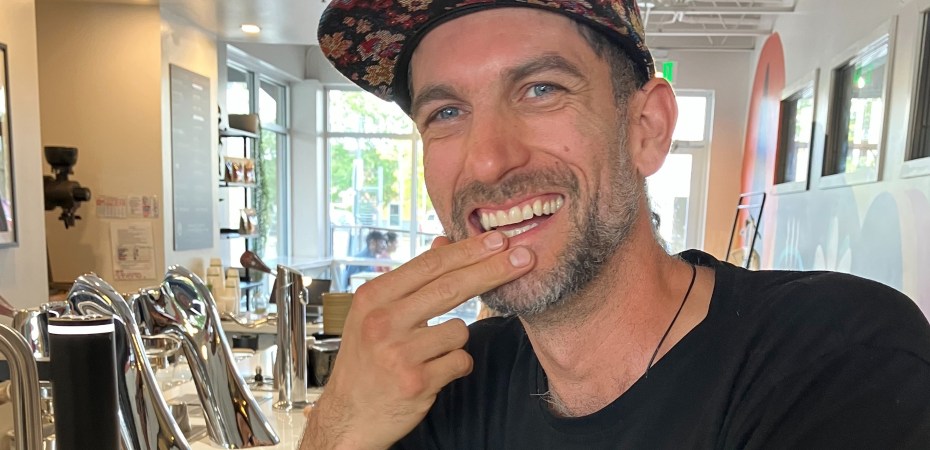
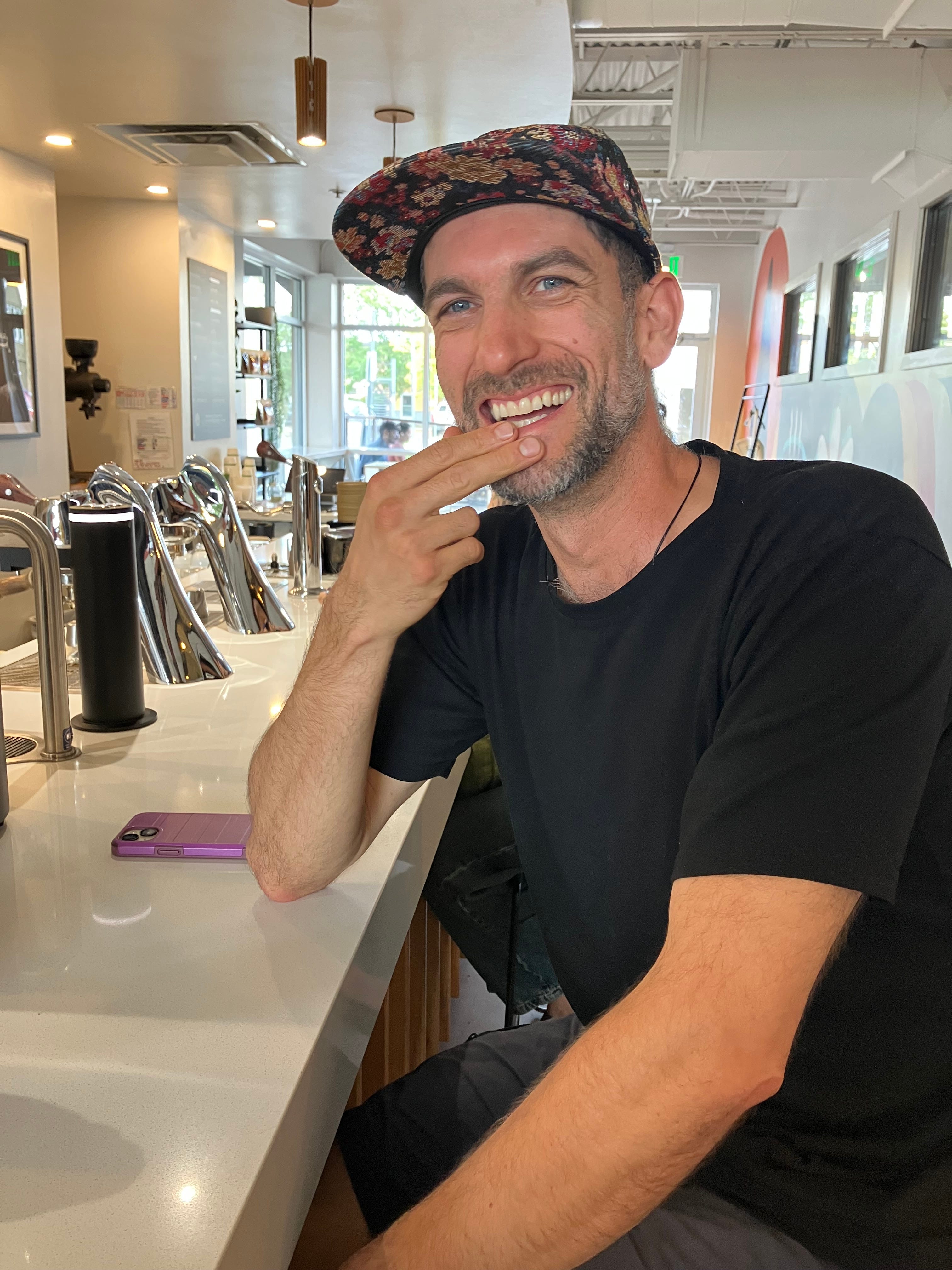
So, in my typical obsolete-on-purpose fashion, I met AJ one afternoon for a non-podcast interview at Verb in Boulder, even tho my iPhone recording would almost certainly fail to compete with the ambient sounds of the busy coffeeshop.
Here are the salvageable highlights, organized and analyzed by Stages of the Open Mic Lifecycle, first introduced in the work of OpenMikeology pioneer, Charlemagne Sanderson (1956)…
Stage I: Initiation: The Poet Discovers The Scene
I had finally started hearing poems and poets that sparked me and started hearing poems that let me, like, see God… just like that holy, deep, deep language. And it was really inspiring. And then here was this coffee shop centered on poetry…
The Poet’s pre-Scene life can vary. Some write and appreciate poetry for many years Scenelessly, while others may not know the difference between a haiku and a high-chair before they step foot into a Mic. But, whether intentionally sought out or accidentally stumbled upon, there is something about that first moment of discovering a group of people publicly reading their original poems to each other at a regular time and place every week that can be irresistible to the Poet. Especially after they’ve actually signed up for a slot for the first time and shared some perhaps half-baked but full-hearted piece that to their surprise gets an mm or a laugh or an eye-contact&nod, and they suddenly feel seen in a way they never have before. This is known as “Getting the Bug.”
In the Winter of 2011, AJ Carrillo was a student in the humanities program at the University of Colorado-Boulder. He was taking poetry classes, and becoming inspired by poets such as Charles Olson and Adrienne Rich, and looking for a way to further connect to that spirit by finding his own in-person poetic community beyond the college. It was then he first discovered Innisfree Poetry Bookstore and Cafe, where he Got the Bug and began attending their Tuesday open mic every week.
Stage II: Ascendence: The Poet Becomes a HotNewPoet on The Scene
So that was really nourishing to be able to go to those open mics, read my own work, hear other people, and be a part of that energy.. And that was great for a while, you know, that really sustained me.
There are some Poets who Get the Bug harder than others, and that drive and passion combined with a rapidly developing Way-With-Words may lead them to be regarded as Hot or having “It.” Poetry audiences like Hotness and will pay extra attention to those performers and clap harder for them and maybe tell them afterward how great they were and then possibly become their friends and lovers. Many Poets have never received this kind of attention and validation before and do not have other means in their lives for achieving it and become dependent on the Open Mikes for the chemical rush it provides them.
Carrillo is far too humble to boast about his epic Metropolis-style poetry performances, but he may acknowledge they were serving an internal hunger for validation and belonging. He quickly became a core part of the Innisfree community, which extended to other groups at the time like the Eagle’s Nest communal living space who began the monthly ‘Wine & Poetry’ event, which the Rad-ish Collective continued for several years. Like many poets, Carrillo most thrived in what we call a ‘Home Reading,’ at Innisfree, which tended to be a younger college crowd and a space that lent itself to a quieter, more attentive audience compared to other Mics, in which you might have to square off with a random crowd of General Zods on any given week. It was the Innisfree community support that allowed Carrillo to fully inhabit his Man-of-Steel* energy (*not to be confused with Jim “The Man of” Steele).
Stage III: Graduation: The Poet Voluntarily Departs from The Scene
Yeah, I think I wanted more, and then when it wasn’t coming about, maybe I got a little discouraged. That maybe made it so that I didn’t go as often. And then that coincided with just naturally moving away from it as I started my own company. I was in a committed relationship, and we were moving towards our careers and our dreams. And we moved.
While some Poets are never able to Graduate from the Scene, it is far more common that they do. Whether HotNewPoet or just more casual participant or audience appreciator, there are many factors that lead someone to naturally withdraw from regularly attending the Mics. They may find friends and lovers who fulfill social needs independently of the Scene. Or they may get Adult jobs or have children which change priorities and take up time and energy. While others simply move away from town for one reason or another – in an expensive, high turnover college town like Boulder this is especially common. Unlike graduation from an educational institution, there is, with few exceptions, no ceremony or pomp&circumstance or tossing of tassels. Instead it’s usually just an unannounced Yeats Goodbye, aka Basho Sayonara, aka Rimbaudian Aurevoir.
For Carrillo, it was partly the Mic no longer serving his spirit to the same extent, but also that other aspects of his life started to fill the same needs. He met his wife Nicole their senior year of college through poetry classes, where they found they shared similar tastes and passion for it. At first they attended readings together, but the energy of the new relationship quietly replaced the thrill of performance for Carrillo. Soon they were very literally graduating, and their plans led them to move away from Boulder to Colorado’s Western Slope with nary a whisper.
Stage IV: Latency: The Poet Does Not Belong to any Scene.
I was really socially alienated. I was so busy. I was stressed. And so I wasn’t really looking for anything [Open Mics] at that time. And I think if I were to, it would have felt like so much energy just to show up. I just didn’t even try.
Once Graduated, the Poet may disperse from the Scene both geographically and emotionally. Poetry can feel at times as if it has no relevance to their life and, in fact, can only be a counterproductive sidetrack. What does poetry have to do with working a job, paying the bills, keeping a relationship going, taking care of kids? But under the surface and in the quieter moments they may also start to miss their former life on The Scene, when their only responsibility was getting inspired to string together never-before-heard word combinations to the delight of the crowds and the Gods of Literature.
AJ worked in landscape design and then agriculture, which he describes as a “5 to 9” rather than 9 to 5 kind of job. Working on the farm left him completely exhausted with no time or energy for a creative life. This lasted for a full ten years of his life.
Stage V: Reemergence: The Poet Returns to The Scene with New Insights
I was really craving social connection. I was really craving a sense of personal identity again… I was like, well, what do I even like? What have I liked in the past? Oh, wait, yeah. I wonder what’s going on in poetry…
Most Graduated Poets never return to the Scene in any capacity, much like most students wouldn’t enroll in classes again after receiving their diploma. They may legitimately and permanently replace the need for it with other outlets in their life. Or they may desperately yearn for it but see no route by which to return. They may doubt their ability to regain the Heat they once so easily emitted, or may question whether their increasingly archaic style and themes and touch-of-gray-in-the-beard even belongs in such a young-person’s game anymore. And if any little distraction or fatigue arises it’s enough to keep them hooked to their usual preferred distraction mechanisms. But for a rare few, they are able to summon a sense of purpose and energy, at least for a moment, that propels them back into the Scene. They are often not the same poet they used to be, but this is not necessarily a bad thing. They may return with new insights about things like their need for external validation and the intrinsic value of poetry even if just for themselves.
After his daughter was born, AJ and his family sold their farm and moved back to Boulder where he pursued a graduate degree. He began working as a project manager for an environmental design company which allowed for a more reasonable 9-5 schedule and freed up more time and energy. This led to rediscovering So You’re a Poet and bravely showing back up one Monday night. There was insecurity at first as he attempted to fit back into the style from his past, but soon realized he could let that go and allow a new poetry to develop based on where he was currently at in life. This allowed him a new perspective on the open mics – more of just a humble sharing of what matters to him rather than trying to win over the audience like he used to. With this approach he can feel a sense of satisfaction no matter the external response. This also means he feels no obligation to regularly attend the mic or get deeply involved in The Scene again. It can just be when he feels moved to do it.
Stage VI: Legacy: The Poet’s Impact Beyond The Scene
I’m always thinking about the ecology, the ecosystem. Yeah, we can grow a bunch of trees in a plantation, but that’s not an old growth forest, you know? And we can destroy an old growth forest and turn it into money, but then what do you have? These are the sort of questions that poets get to ask. And that’s a lot of where I come from, and I bring that sensibility to decision making and to design work.
We tend to think of a Poet as needing to be part of a Scene in order to fulfill their identity, but the latest OpenMikeology research suggests that it is more of a way of being, which can apply to and benefit any realm of life they occupy. The Poet sees the world in terms of all the creative possibilities instead of what’s just expected. They are also able to provide the empathic human perspective to any discussion. In a sense, a Poet is needed in every room in which an important decision is being made, to push back against our most stale and selfish urges. The Poet who returns after Graduation is particularly well equipped for this role, because of the new insights gained from their hiatus. They are able to exist without the Scene, so once tapped back into their poetic practice they are able to bring those gifts to the wider world.
While AJ attends the open mics again sporadically, and would like to possibly have his work published one day, perhaps his greatest impact as a Poet is in his landscape design company which specializes in green infrastructure. He is in a position to make decisions about sustainability, climate management, and protecting ecosystems, while also ensuring human quality of life. When they are tasked with something like finding the best way to drain a puddle, we can trust that there is a Poet in the chain of command who has a bigger picture of things in mind.
Heritage


Our birthright as

stewards of the Earth


is to leave

the wings of Eden

in our wake —


- AJ Carrillo
Graduation-within-TheScene
Could such insights be reached about the transcendence of the Open Mic if we are only to study HotNewPoets? Unlikely. In fact, maybe we should all aspire to be ColdOld-Graduated-yet-Returned Poets.
If involved in The Scene long enough, the UnGraduated Poet may find themselves trapped in what’s known as Scene Inertia, unable to exit, whether the expected psychological payoffs have eroded or not. UnGraduation is known, in many cases, to escalate spiritual ickiness the longer it endures. Over time, Getting the Bug has a way of gradually and Kafkaesquely metamorphosizing you into a Bug yourself. Often with the Poet unable to accept their Coldness, nostalgically holding on to long lost Hotter primes, reluctant to accept and nurture the New Poets coming into their own, and struggling to move forward as they lie shell-to-ground with multitudes of once formidable but now bent antennae and crawly crawl-legs flailing helplessly into the air.
Perhaps hope lies in a fringe theory of OpenMikeology known as Graduation-within-TheScene, in which The Poet changes their relationship to the Scene without having to leave it. While some OpenMikeologists believe Inertia creates habits too rigid and ingrained for this to be possible, others counter that with the right kind of ColdOldPoet interviews and enough spoofery of academic jargon, the Poet may approach the Mics with a new upright and bipedally evolved perspective of their Graduated counterparts.
Purpose


To sprout,

flower

and fruit —


to pass

the old

on to the new.


- AJ Carrillo
Jonathan Bluebird Montgomery is the founder and editor of Boulder Poetry Scene. The author of Pizzas and Mermaid, The Reality Traveler, Nine Books (at Once!), and Jonathan and The Awesomenauts, he’s been on the Boulder poetry scene since he first came to get his MFA at Naropa’s Jack Kerouac School in 2003. You can find more of his work at jonathanbluebirdmontgomery.com or subscribe to his Substack here
 Boulder Poetry Scene